Neurodivergent people have many talents that can add value to the IT industry. Autistic people can be strong logical thinkers, highly focused, detailed orientated, reliable and loyal. ADHD people tend to have high energy and strong imagination. Dyslexic people can bring out-of-the-box thinking and pattern recognition. Dyspraxic people tend to be really good at strategic thinking and problem solving, and highly motivated.

There is no question that neurodivergent talent can add value in a variety of technical and business roles in the IT industry. So, we don’t need to ask, “What can neurodivergent people do for the IT industry?” The answer, unequivocally, is a lot.

We need to change the perspective. We need to ask ourselves what we can do better to attract and retain these talents in IT buyer and supplier organisations.

In a previous blog, I talked about how cities should think of how to become autism friendly, including through the intelligent application of technology. In this piece, I’m reflecting on how the technology industry itself can make the workplace more autism friendly.

Making the IT Industry Autism Friendly

According to Digital Scotland, 10% of Scottish people are neurodivergent, but many of them are unemployed. In fact, the UK Office of National Statistics’ research shows that just 22% of autistic people are in any kind of employment, but many more are eager to work. That’s a lot of wasted talent for the IT industry at a time when there’s a dire shortage of talent.

According to our surveys, around 74% of European organisations find it difficult or very difficult to hire technology roles in either line of business or IT. Most importantly, that’s a lot of unaccomplished self-fulfilment and happiness for autistic people.

The good news is that the IT industry has started to pay attention. On the technology buyer side, the Israeli army recruited autistic soldiers for a highly specialised visual intelligence unit. On the supplier side, IBM established the ND@IBM BRG (Business Resource Group), which includes neurodivergent employees and allies in IBM offices across the globe.

SAP, Microsoft, DXC and EY have invested to raise awareness both among their employees through internal webinars and training, and for the overall industry by sponsoring Autism at Work Summits. There are even companies that make neurodivergent talent their core asset, such as Auticon, which provides quality assurance, testing, data science and cybersecurity services with a delivery workforce that includes around 400 autistic consultants in its 20 offices.

There’s a long way to go, but these examples show that a different perspective on autism at work is possible for the IT industry. Companies embracing this new perspective need to consider that matching the skillset of neurodivergent people with the right projects and activities, and raising awareness, are only the first steps in the process.

Success comes from changing recruiting and hiring processes by finding alternatives to one-to-one interviews, which can be a barrier for people with gaps in their social skills. For example, they could combine cognitive written tests with week-long workshops, where psychologists bring candidates together for group work and meals to evaluate their individual soft skills.

Workspaces need to be adapted. Just as an employee in a wheelchair may need a ramp, an autistic person may find a low-light, low-noise environment more conducive to concentrating. Psychologists need to be retained as job coaches to help prevent situations that cause anxiety, based on each individual’s profile, and to facilitate interaction with clients.

Dress codes need to be relaxed for autistic people that may be hyper-sensitive to touch and therefore can’t wear certain fibres. Neurotypical employees must be immersed in teams with neurodivergent people to learn how to interact.

A simple change of language from “I need this deliverable to be completed ASAP” to “I need this deliverable to be completed by tomorrow at 5pm” makes an immense difference for an autistic person. The former quite simply does not make sense, and just creates anxiety. The latter provides a clear deadline that an autistic person can meet.

Neurodivergent talent can bring a different perspective to help IT buyers and suppliers avoid bias when tackling business and technical problems in our fast-paced industry. All we need is a change in mindset to make the IT industry a good place to work for neurodivergent talent.

Massimiliano Claps - Research Director - IDC

Massimiliano (Max) Claps is the research director for the Worldwide National Government Platforms and Technologies research in IDC's Government Insights practice. In this role, Max provides research and advisory services to technology suppliers and national civilian government senior leaders in the US and globally. Specific areas of research include improving government digital experiences, data and data sharing, AI and automation, cloud-enabled system modernization, the future of government work, and data protection and digital sovereignty to drive social, economic, and environmental outcomes for agencies and the public.

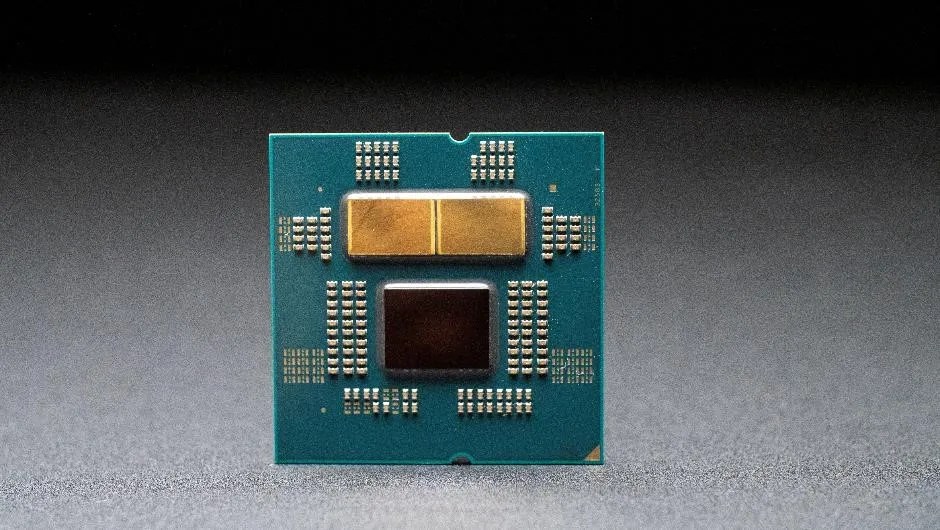
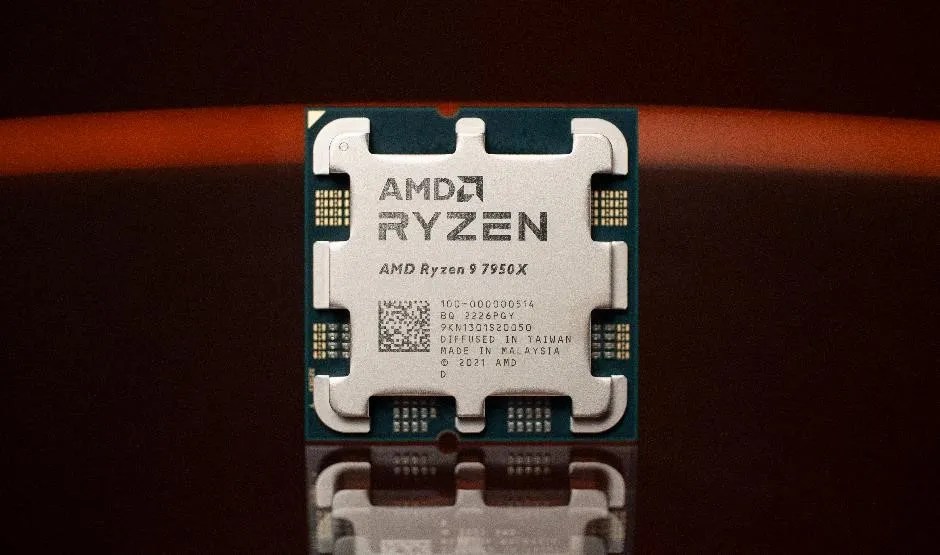
AMD made major changes to its CPU and GPU portfolios in 2022. On August 29, AMD unveiled its Ryzen 7000 series of desktop processors powered by Zen 4 architecture and the new socket AM5 platform. These processors have been available globally from September 27. The flagship 16-core AMD Ryzen 9 7950X processor is presently offered at the manufacturer’s suggested retail price (MSRP) of $699.

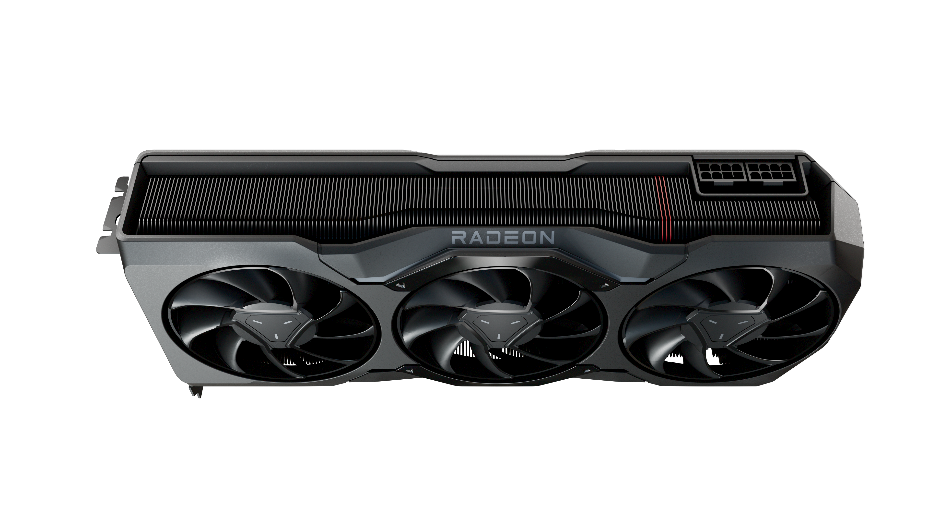
On November 3, AMD unveiled the Radeon RX 7900 series of graphics cards powered by RDNA 3 architecture. The cards have been available on AMD’s website from December 13, 2022. Leading AMD board partners, including ASRock, ASUS, Biostar, Gigabyte, MSI, PowerColor, Sapphire, Vastarmor, XFX, and Yeston, have offered the cards from mid-December. The Radeon RX 7900 XTX has a starting price of $999, while the AMD Radeon RX 7900 XT has a $899 price tag.

AMD offered samples of the Radeon RX 7900 XTX along with the Ryzen 9 7950X processor, a socket AM5 motherboard, and a DDR5 memory kit. The samples allowed IDC to test how well AMD’s flagship technology platform performed as a completely new system or upgrade over an existing system. IDC also gauged how well the new samples performed over prior generations in terms of performance per watt and computations per U.S. dollar.

What’s New with the AMD Ryzen 7000 Series Desktop CPUs?

The core compute die of the Ryzen 7000 series processor is built on TSMC’s 5nm process node. The input/output die — which now includes basic RDNA 2 graphics capabilities for 2D workloads or diagnostic/troubleshooting purposes — is based on TSMC’s 6nm process.

AMD made a significant change by moving from the previously long-lived AM4 socket platform to the new LGA AM5 socket. Since pins have moved from the CPU to the socket, there is less risk of damage during installations or upgrades. The AM5 platform also supports dual-channel DDR5 memory up to 5200 megatransfers per second (MT/S), in line with JEDEC standards.

AMD has invested in a memory configuration standard it has branded EXPO. EXPO supports advanced pre-configured profile settings designed specifically for AMD memory controllers built into DIMM boards. These pre-configured profiles simplify overclocking for greater bandwidth and tighten timing for the fastest responses and lowest latencies.

The new socket AM5 motherboards have up to 24 PCIe 5.0 lanes and are available with AMD X670E chipsets. In addition to possessing the highest overclocking capabilities, the enthusiast-grade X670 and B650E motherboards support the PCIe 5.0 standard for graphics and storage components. However, PCIe 5.0 support is an optional feature on the mainstream B650 motherboard.

AMD has pledged to support AM5 motherboards through 2025 and at least two subsequent CPU generations. However, support may be provided even longer if the long history of the AM4 series is anything to go by.

What’s New with the AMD Radeon RX 7900 Series GPUs?

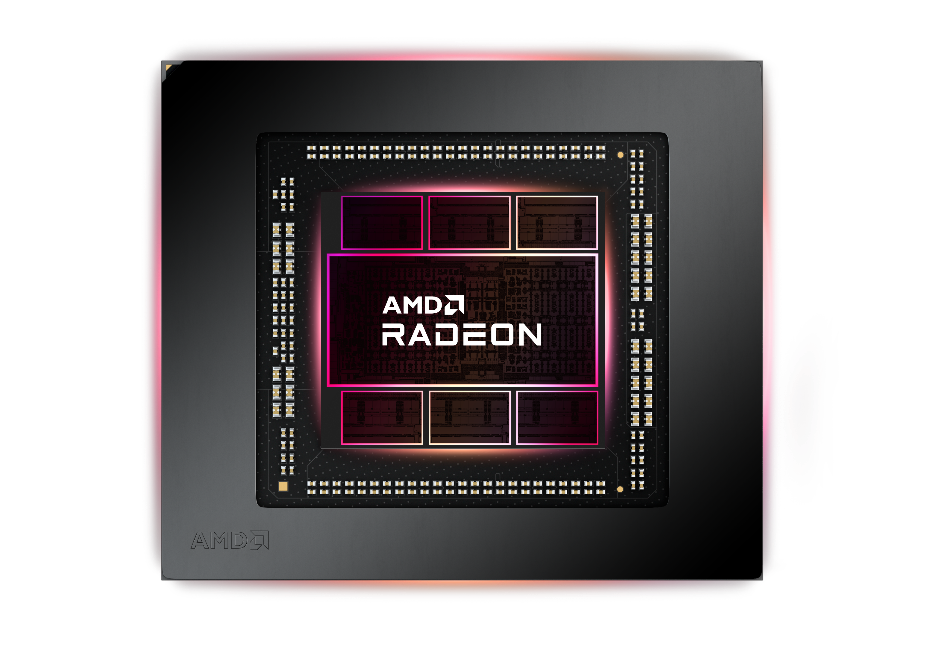
The AMD Radeon RX 7900 XTX and Radeon RX 7900 XT graphics cards are the first gaming cards to feature an advanced chiplet design. Like the Ryzen 7000 series, the AMD RDNA 3 generation architecture’s chiplet design combines 5nm and 6nm process nodes. The main graphics compute die (GCD) is built on TSMC’s 5nm process and provides the compute units for rasterization and ray tracing. AMD includes up to six TSMC 6nm memory cache dies (MCDs), each with 16MB of second-generation AMD Infinity Cache technology and a 64-bit wide memory interface. AMD invested in a novel interconnect to link the GCD and MCD chiplets together, enabling bandwidth of up to 5.3TB/s.

The AMD Radeon RX 7900 XTX has 96 compute units. Each has four texture units (for 384 in total), one ray accelerator (96 total), and two artificial intelligence (AI) units (192 total). According to AMD, the performance of the ray tracing units in RDNA 3 architecture is nearly double that of the corresponding units in RDNA 2, while the new AI instructions are nearly three times as many as those in the previous generation.

The AMD Radeon RX 7900 XTX features six MCDs that support 24GB of GDDR6 memory running at 20Gbps over a 384-bit bus. The Radeon RX 7900 XTX also supports USB-C, DisplayPort 2.1, and HDMI 2.1a connectivity with UHBR 13.5, allowing displays with high refresh rates to be connected (up to 480Hz refresh rates on 4K panels and 165Hz refresh rates on 8K panels). A dual media engine supports simultaneous encode or decode streams up to 8K60 for HEVC, as well as the new AV1 codec.

The Test Platform

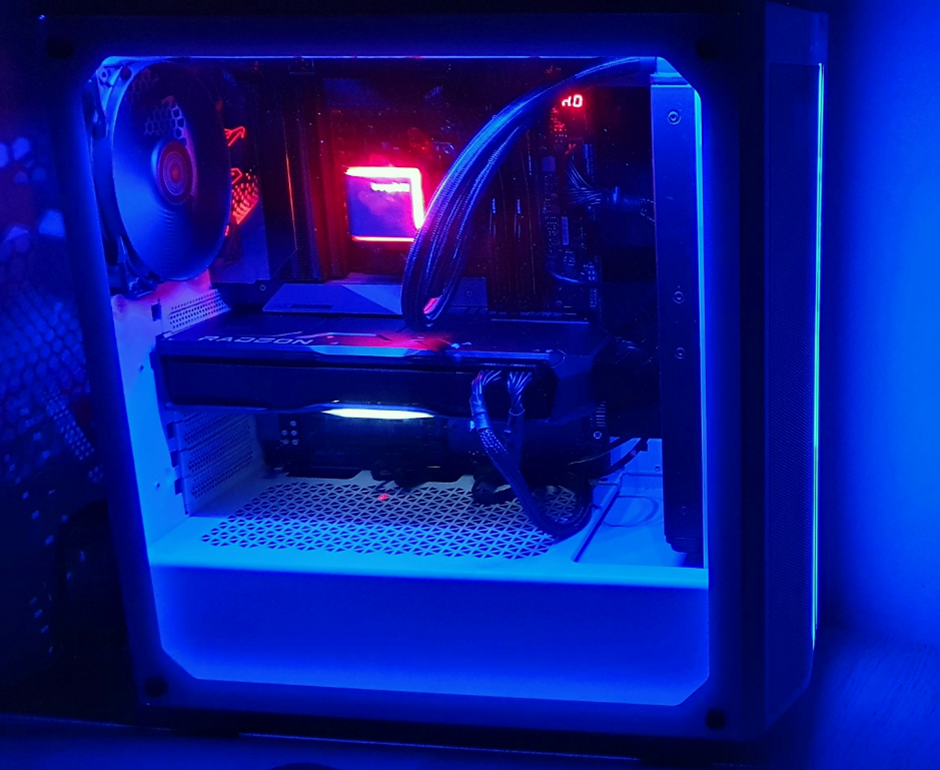
The test PC hardware components included the AMD Ryzen 9 7950X processor, the Radeon RX 7900 XTX graphics card, the Gigabyte X670E Aorus Master motherboard, and a G.SKILL Trident Z5 Neo 2x16GB DDR5-6000 EXPO memory kit. The Windows 11 main drive was a 1TB GIGABYTE AORUS NVMe Gen4 solid-state drive.

A be quiet! Silent Loop 2 280mm water cooler was installed for the processor, which was paired with a be quiet! STRAIGHT POWER 11 Platinum 850W power supply. A 34″ Dell Gaming S3422DWG monitor — a Quad-HD 3440×1440 display with a 144Hz refresh rate, FreeSync, 10-bit colors, and high dynamic range support — was also utilized.

The reviewer utilized the motherboard’s optimal default settings, set the memory profile to EXPO 6000, and made sure that smart access memory was enabled. No special tuning, optimization, or overclocking was carried out for the tests.

Synthetic Benchmarks and Productivity Performance

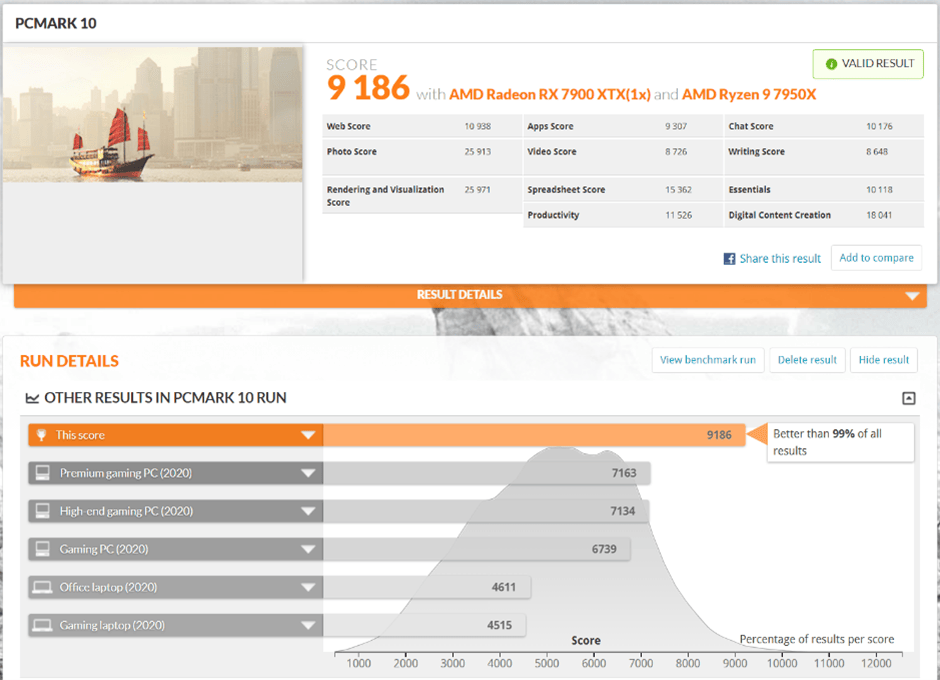
PCMark 10 is a comprehensive benchmarking tool that covers the wide variety of tasks performed in the modern workplace. Web browsing, videoconferencing, spreadsheet and word-processing workloads, photo and video editing, and rendering and visualization are some of the tasks tested by PCMark 10.

The gaming test focused on real-time graphics and physics engines of the platform hardware. The 9,186 score the platform achieved was better than 99% of all results produced by PCMark 10.

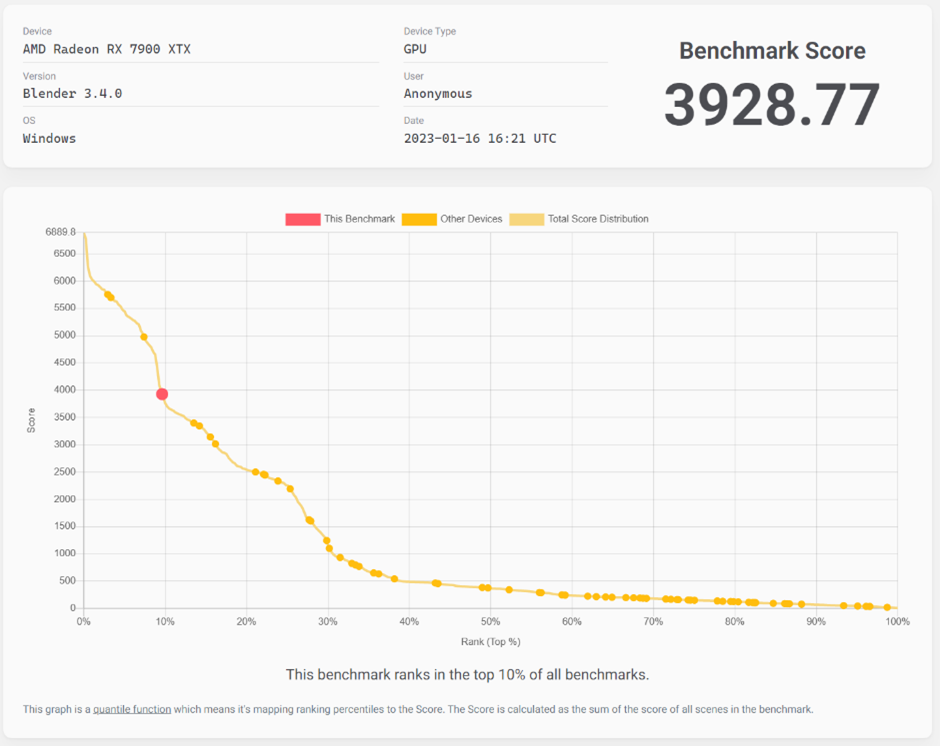
Blender Benchmark 3.4.0 was used to test the rendering performance of the graphics card. Thanks to the Heterogeneous Interface for Portability — AMD’s compute language for GPUs which Blender Benchmark uses (in contrast to OpenCL, which does not) — the Radeon RX 7900 XTX ranked in the top 10% of all benchmarks, delivering an excellent result.

IndigoBench, an OpenCL benchmark based on Indigo 4’s advanced rendering engine, was used to measure the performance of the Radeon RX 7900 XTX. The AMD Radeon RX 7900 XTX achieved 21.500 M samples/s in the bedroom rendering test and 49.599 M samples/s in the supercar rendering test. According to the published test results, the graphics card was 56% faster than the Radeon Pro W6800 and 51% faster than the 6900 XT.

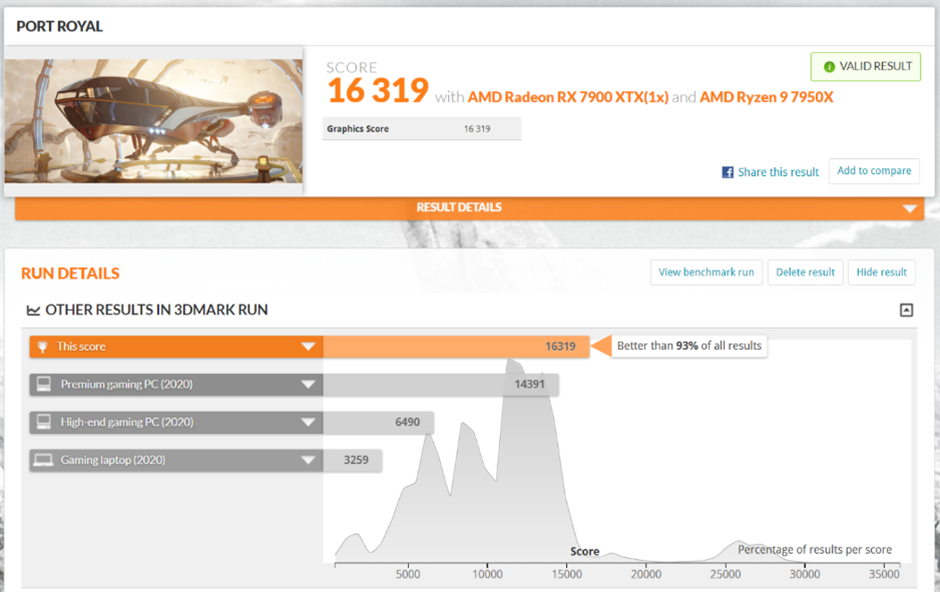
3DMark Port Royal is a dedicated real-time ray tracing benchmark for gamers. The system’s score of 16,319 was better than 93% of all results and almost double the 8,784 score of the older AMD Ryzen 9 5900X and Radeon RX 6800 XT system.

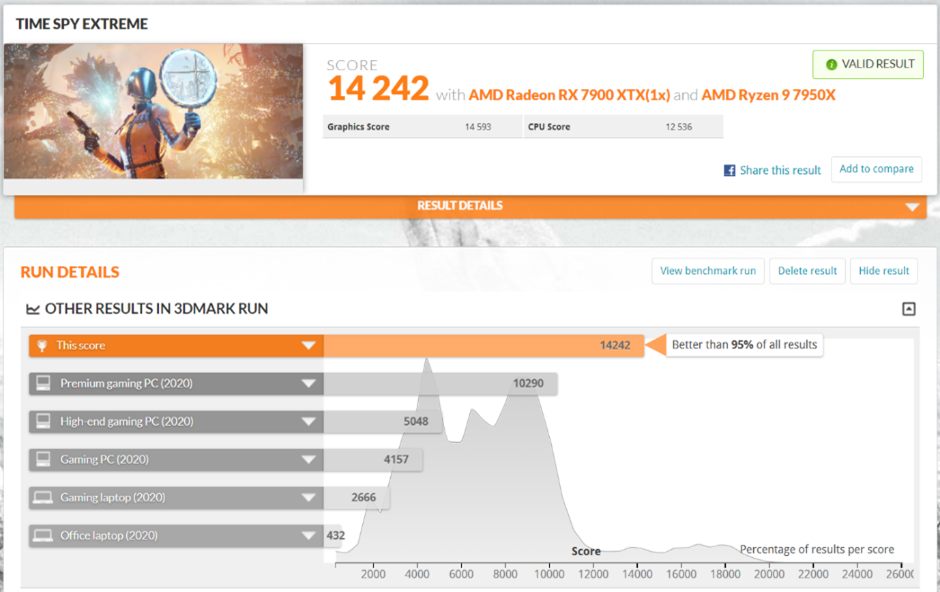
The system’s 3DMark Time Spy Extreme 4K score of 14,242 was better than 95% of all results. The graphics score of 14,593 was 48% higher than what was achieved by the AMD Radeon RX 6800 XT on the same Ryzen 9 7950X platform.

Gaming Performance

Various old and new video games were tested on the platform, including next-gen versions.

Shadow of the Tomb Raider

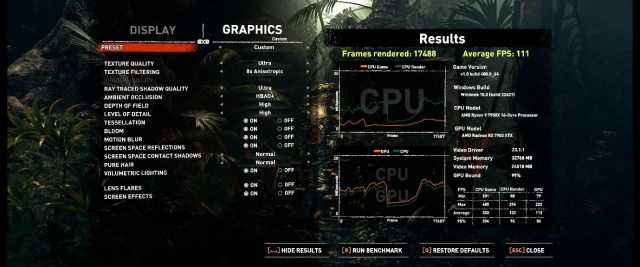
This game ran at an average 111 frames per second (fps) at 1440p, registering a minimum of 79fps. The highest graphical settings, as well as AMD’s FidelityFX CAS package, were enabled.

FARCRY6

Far Cry 6 ran at an average 140fps at 1440p, registering a minimum of 123fps. All DirectX Raytracing (DXR) and FidelityFX Super Resolution (FSR) features were enabled during testing.

Cyberpunk 2077

Cyberpunk 2077 ran at an average 67fps at 1440p, registering a minimum of 49fps. Ultra-ray tracing presets and FSR 2.1 features were automatically enabled.

The Witcher 3 Wild Hunt Next-Gen

The Witcher 3 Wild Hunt Next-Gen ran at an average 75fps at 1440p, registering a minimum of 60fps. Ultra-ray tracing presets and FSR 2.1 features were automatically enabled.

Fortnite

The latest Fortnite game runs on Unreal Engine 5.1 and makes use of several next-gen features (such as Nanite, Lumen, Virtual Shadow Maps, and Temporal Super Resolution). For example, the Lumen Global Illumination and Lumen Reflection features can exploit the Radeon GPU’s hardware-accelerated ray-tracing capabilities. The updated game ran at an average 82fps, with a 65fps minimum.

IDC Opinion and Conclusion

Ryzen 7950X Performance, Power Consumption, and Heat Considerations

With the Ryzen 7000 generation of desktop CPUs, AMD has taken a new approach to delivering maximum performance. Rather than limit power, AMD allows its CPUs to consume as much power as needed within the socket and reach their thermal throttling temperature (for the Ryzen 9 7950x, the throttling temperature is 95°C). With a much higher CPU thermal design power of 170W in comparison to 105W for the Ryzen 9 5950X, the 7950X reached much higher single threads and all core boost clocks, increasing overall performance and speeding up challenging productivity tasks.

However, enhanced cooling is needed to maintain the performance of the processor (this means increased fan noise). The system and cooler’s fans will quickly ramp up to high speeds when the processor is executing a demanding workload.

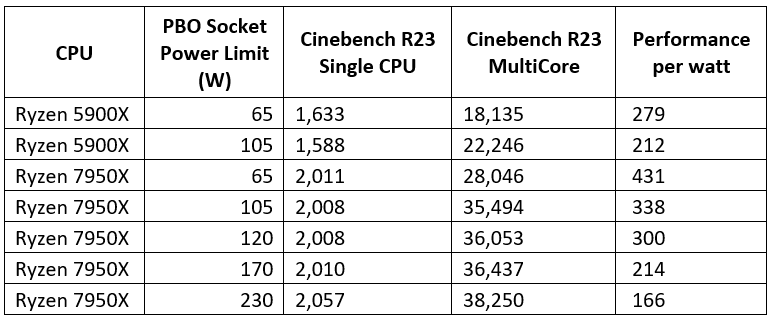
AMD provides several tools for performance and efficiency customizations. For example, Precision Boost Overdrive (PBO) is a feature that has dramatic impacts on power consumption, heat, and noise as it enables users to set overall socket power. On the test system, PBO had a major impact on the power consumption of the Ryzen 9 7950X, with only minimal drawbacks in terms of performance.

For example, the Ryzen 9 7950X running at 105W delivered 93% of the performance and used just 46% of the power of a higher 230W system setting. When AMD’s suggested 65W “eco mode” setting was used, the test platform delivered 73% of the performance and used 38% of the power of the 230W setting. While this configuration flexibility is a welcome change, AMD should make it simple and easy for users to change PBO socket power profiles on the fly. AMD could work with Microsoft to enable this capability via the power management features of Windows 10 or 11.

Radeon RX 7900 XTX Considerations

On the GPU side, AMD has increased the GPU power draw to 355W. This is a 55W increase over the 300W draw of the Radeon RX 6900 XT and RX 6800 XT but only a 20W increase over the Radeon RX 6950 XT. Overclocking delivered small gains of around 200 points in 3DMARK tests and slightly boosted gaming fps, but at the expense of increased power consumption, heat, and fan noise. The RDNA 3-based Radeon RX 7900 XTX can hit frequencies of up to 3GHz, with additional power available on AIB partner cards that include a third 8-pin PCIe power connector and significantly enhanced cooling systems compared to AMD reference card designs.

As with the Ryzen 9 7950X, reducing the GPU power limit and undervolting the graphics card significantly reduces overall temperatures and noise for only a few percentage drops in gaming performance.

AMD Ryzen 7000 Series Pricing

AMD faced some criticism about the Ryzen 7000X series and AM5 platform at launch. Although the pricing of the CPUs was competitive, the initial AM5 motherboards based on the X670E chipset were limited in choice and very expensive. This was compounded by the high price of DDR5 RAM (in comparison to DDR4).

AMD has since lowered the price of the Ryzen 7000X and introduced more cost effective and lower power non-X series of CPUs (the 6-core Ryzen 5 7600, 8-core Ryzen 7 7700, and 12-core Ryzen 9 7900). AMD board partners have also introduced a wider range of AM5 motherboards based on the X670, B650E, and B650 chipsets. Volume production of DDR5 has also resulted in more cost-competitive memory options.

AMD Radeon 7900 XTX Pricing

The European street price of the Radeon 7900 XTX is around €1,130, which is higher than the American $999 MSRP listed on amd.com, due to fluctuating exchange rates and taxes (e.g., value-added tax). The cards from board partners are in some cases more expensive, chiefly due to their beefed-up coolers, uprated power systems, and the additional margins of the board manufacturers and their channel partners.

It does not make sense for AMD to lower its profit margins, especially on niche flagship products. AMD’s key competitor asks higher prices for cards in the same category. At the same time, customers may not actually benefit from lower prices in some instances due to intermediaries such as channel partners or scalpers.

It’s getting harder to find a bargain these days, but with an MSRP of $999, the RX 7959 XTX reference card is actually $100 cheaper than the previous generation RX 6950 XT, despite having more compute units, more RAM, a wider RAM interface, and a significantly better performance. This should come as good news for high-end gamers.

User Experience

There are a few user experience challenges with the AMD AM5 platform, some of which are created by partners. For example, updating the motherboard BIOS may be difficult for some users. In fact, updating the BIOS of the motherboard in the test system failed a few times — the reviewer only discovered that the older BIOS first needed to be set to a default state before an upgrade could be made after carrying out a bit of reading and research. Fortunately, new standard features (e.g., BIOS flashback) simplify the recovery process when experiments with settings make a system unbootable and clearing CMOS memory does not work.

Another example is when the reviewer found that when games such as Hell Let Loose, Fortnite or Genshin Impact were launched, a sudden surge in frame rates can dramatically bolster power and voltage consumption. Fortunately, AMD has countered this issue with safety mechanisms that turn the device off when such surges are detected. After carrying out various tests and checking the health of system components, the reviewer found that these problems can be solved by establishing a frame rate cap (e.g., of 240fps), using Radeon Software.

Casual users who encounter such issues may feel displeased with the overall experience, particularly if they have to spend hours troubleshooting with systems integrators or manufacturers. They may attribute the problem to the AMD platform, rather than a poor job from the software house, in capping the frame rates.

AMD Advantage

The AMD Advantage framework combines Ryzen 7950X processors, Radeon RX 7900 XTX graphics cards, the AMD Software: Adrenalin Edition application, and smart technologies to deliver the best experiences to gamers and creators. The company works closely with prominent system integrators, including CSL, Cyberpower, eBuyer, Falcon Northwest, Maingear, Origin PC, and XIdax, to bring stable and enhanced experiences to gamers, streamers, and content creators. Customers who want to avoid the headache of troubleshooting issues during PC buildouts or upgrades will be pleased with AMD’s investments in additional testing, certification, and support.

Performance

AMD is innovating on multiple levels. The company is enhancing core architecture for inter-process communication gains, improving chiplet design for scalable manufacturing, making cache enhancements for memory intensive workloads, and supporting process and design improvements for clock speed increases. As a result of these efforts, its new products are 30–50% faster than previous generations. The company is not holding back or milking the market with small, incremental gains. Competition is one of the biggest drivers of innovation. As such, the performance improvements of AMD CPUs and GPUs are benefiting the entire market.

The move to PCIe 5 and DDR 5 will future proof the new platform. The inclusion of technologies — such as EXPO memory configuration profiles — will make performance improvements simpler and more accessible to the wider PC market.

AMD is also investing in backend software development with ISVs. AMD is collaborating with Adobe, Blender, and OBS to improve hardware acceleration across CPUs and GPUs for content creation, productivity, and encoding, decoding, and streaming use cases, thereby adding productivity value to the gaming cards.

Final Words and Conclusion

According to IDC’s monitor tracker, 1440p is the fastest-growing screen resolution. In addition, 3% of users buy 4K and higher-resolution displays. As these users are the target customers for high-end hardware, AMD is on the right track.

However, AMD has increased the power draw of its CPUs and GPUs to deliver a high level of performance. Per IDC tests, power consumption can be dropped significantly in many cases while still maintaining over 90% of peak performance. In turn, this drop can lower noise and energy bills. AMD can provide users with the best of both worlds by making it simple to switch performance profiles depending on the particular workload.

In conclusion, AMD has certainly taken a big step forward with its new generation of CPUs and GPUs. AMD’s 2023 desktop platform is taking 1440p gaming mainstream and making 120–140Hz refresh rates the norm. The new platform also makes 4K gaming possible at 60fps with the highest graphical settings achievable at native resolutions or with FSR. For this and other reasons, including AMD’s well-earned reputation for remedying challenges and aging very well, we have no issues with recommending the platform.

Mohamed Hakam Hefny - Senior Program Manager - IDC

Mohamed Hefny leads market research in EMEA on professional workstation PCs and solutions. He also reports on professional computing semiconductors, processors, and accelerators (CPUs and GPUs), as well as breakthroughs and trends related to the market. In addition, Mohamed is actively involved in AI PC taxonomy and research. He participates in business development projects, contributes to consulting activities, and provides IDC customers with analysis, opinions, and advice.

When organizations in all industries are struggling to attract talent, IDC explores opportunities for dealing with this shortage.

Introduction

Organizations in all industries are struggling to attract talent. The shortage of potential employees is a problem that has plagued the IT sector for years but has possibly never been worse than it is now. In this blog IDC explores opportunities for dealing with this shortage.

Employee Benefits

The most obvious perspective to consider is that of salary. Benchmarking employee expenses will allow your organization to match your peers and stop losing employees over salary competition.

Another benefit of benchmarking salary cost is tackling the possible internal tug of war for budget increases. An independent benchmark report is often useful to convince senior management that additional budget is required, if the benchmark points this out.

However, employees are not motivated by salary alone. For many, satisfaction also comes from working on cutting-edge technology, something that only some IT organizations allow an employee to do. In contrast, maintaining legacy systems at less competitive organizations may not be interesting to IT professionals who love to experience technology. In a benchmark, the technologies maintained by the IT staff are closely examined and compared to peers. IDC identifies key areas to innovate your business’ digital transformation, keeping IT staff engaged at the same time.

Optimize Your Current Environment

Another perspective to take is optimizing the existing situation. If finding new IT talent is challenging, IT management must consider ways to maximize the use of existing employees. With talent being as scarce as it is, management must be fully aware of possible optimizations.

A benchmark will show how teams are performing in terms of productivity and where potential exists.

Because IDC’s data collection methods dive deep into your IT administration and governance, gaps that no doubt exist are discovered and reported on. The results of a benchmark will uncover where your automation is lacking and whether your end users are educated to market conform levels. All of these insights will allow you to deliver more and better IT with the resources that you already have available.

Rationalizing and consolidating your IT environment has many benefits and generally offers an attractive business case. That said, possibly the most interesting result is simply reducing the amount of IT that needs to be managed by the talent that is so scarce. The size and complexity of the IT environment is a large factor in our benchmarks, be it the complexity of the networks, the size of the datacenter services, the setup of the end user workplace, or the amount of contract management and governance required. IDC reports on all of these components and shows the way to reducing unnecessary complexity and size.

Is Outsourcing the Way?

Finally, if the options of increasing budgets, optimizing teams, and reducing complexity are exhausted, outsourcing more of the IT services can be considered. Outsourcing can be a relatively quick answer to a suboptimal internal IT team, but it does not come without its share of challenges. The first step is deciding which IT domains are attractive candidates to place under a contract. In other words, an organization needs a sourcing strategy. This strategy will determine how each part of the IT organization should be sourced and what a fitting roadmap to get there should look like. Prioritization of rationalization projects are also considered, as well as the potential to supplement existing teams with external talent from an IT supplier.

Cost is, of course, an important factor in deciding which sourcing scenarios are feasible for the organization. IDC will provide so called ‘landing zones’ in which the future cost of a sourcing scenario are modeled based on the current IT market. This is essentially a virtual benchmark of your IT organization as if parts of it were outsourced.

If IT is outsourced in some way, the existing organization should also change. External contract governance and service management capabilities need to evolve and a future organizational model needs to be constructed. When transforming the organization, one must also consider whether it is attractive to re-educate the existing teams into roles that are needed in the new organization.

The ongoing war on talent is challenging. This blog, however, has hopefully shown that the tools to navigate this challenge exist. IDC continues to help organizations daily and to us, the current market offers new and exciting ways to help CIOs globally.


Generative AI is the buzzword of the day. More specifically, ChatGPT, the OpenAI model that is trained to interact in a “conversational way”.

The dialogue format enables ChatGPT to answer follow-up questions, admit its mistakes and challenge incorrect premises. Of course, like many geeks in the ICT industry and beyond, I have tried it.

It’s quite impressive. Well, besides the fact that it took me a couple of attempts to find the right time of the day when traffic was not so high to cripple access. I asked a couple of questions about my passion, mountaineering and climbing.

The answers were correct, although a bit conservative. For example, when I asked about which multipitch routes I could climb with my level of experience, in Western Canada, the model provided only two options that were exactly in line with my multipitch skills. Instead, I would have appreciated a wider variety of options, some easier and some harder than my skill level, so that I could make a choice.

The model also told me to consult local guides for more information, which indicates that careful ethical principles, like personal safety, are embedded in the design of the algorithm. I then asked about who I should vote for in the upcoming primary to elect the new secretary of the Italian Democratic Party. The answer was that the model can’t express a political opinion, but that it could provide me with the list of candidates.

That’s fair enough, and further proof that ethics are taken into account. So, I asked for the list of candidates and their programmes. The answer was that the model is trained on historical data available until 2021, so it’s not up-to-date on events between 2022 and early 2023. This is understandable, but I would expect it to be quasi real time in the future.

Regardless, fascinating.

Embracing the Augmentative AI Vision

I’ve not done enough research (yet) to say how good the model is and for what use cases. Many of my IDC colleagues are developing thought-leadership research and collecting in-depth data into how generative AI will affect enterprise and consumers.

What I’m thinking about is the societal implications of generative AI. This was triggered yesterday during our first meeting with the 2023 IDC Government Xchange Advisory Board. Gwendolyn Carpenter, a member of the Advisory Board, who has kids in school, said she’d heard about students using it to cheat on their homework.

My colleague Matt Ledger has already written a quick take on this matter too. As Matt noted in his piece, there are a range of opinions on this, from schools that believe ChatGPT can be very valuable as a learning tool, to those that are uncertain about the impact and have temporarily banned usage, to educators that believe that generative AI could make redundant our ability to write, learn and eventually think. This, paradoxically, could hamper our ability to invent brilliant new tools such as ChatGPT itself.

I am no Luddite. I don’t think we should stop progress. But I think generative AI is a great case in point for the ongoing debate about whether we should design AI that can replace human abilities versus AI that can augment human abilities.

For example, I don’t want generative AI to replace my writing, just because it’s much faster and more elegant than I am at synthesising available knowledge. I’m having a lot of fun expressing my opinions in this blog because, in a way, I’m creating it while I write it!

But I would definitely like to have a tool that can critique my writing. A tool that could, for instance, highlight where my piece is biased or where I could consider additional sources of data and literature to enrich my perspective. Sort of a much smarter version of the spell checker that tells me if there’s a typo or if I didn’t use punctuation correctly or if I used too many passive forms. This augmentative AI tool would push my brain to think more, not less. And I’d still be able to make my own choices on whether to apply the advice or not.

Policymakers need to think about how they can shape the new norms to maximise the benefits and tackle the risks of AI. For instance, by recommending (or mandating) a machine-readable label that helps recognise if a piece of content is generated by AI, for example in the case of government-regulated certifications. But regulation is not enough.

If that does not happen, AI will fail to meet the high expectations that it can be a positive force in the future. In fact, according to our Future Enterprise Resilience and Spending Survey (Wave 11, December 2022), only 25% of government executives worldwide think the promise of AI has completely lived up to their organisation’s expectations.

The future of generative AI (and the AI market in general) will depend on whether users and suppliers embrace the human augmentation narrative, in both the B2B and B2C worlds. We need to ask ourselves what kind of AI solutions we want — solutions that replace humans or augment humans. And then design and engineer them in a way that reflects that purpose.

I look forward to discussing more about the power of innovation, and how we can use it at scale to make a positive and ethical impact on society, at our Government Xchange.

Massimiliano Claps - Research Director - IDC

Massimiliano (Max) Claps is the research director for the Worldwide National Government Platforms and Technologies research in IDC's Government Insights practice. In this role, Max provides research and advisory services to technology suppliers and national civilian government senior leaders in the US and globally. Specific areas of research include improving government digital experiences, data and data sharing, AI and automation, cloud-enabled system modernization, the future of government work, and data protection and digital sovereignty to drive social, economic, and environmental outcomes for agencies and the public.